Nobel Prize-winning physicist Eugene Wigner was famously bewildered by what he called the "unreasonable effectiveness of mathematics" in the natural sciences. Throughout history, mathematicians have developed incredibly complex, abstract structures—often purely for the sheer intellectual joy of solving puzzles in a theoretical sandbox. Yet, decades or even centuries later, physicists inevitably discover that these exact abstract games are the literal, precise language the physical universe uses to operate.
This baffling phenomenon forces us to confront a profound question: when we construct mathematical formulas or have a truly original thought, are we inventing something new, or is our biological brain simply acting as a highly tuned antenna locking onto a mathematical frequency that has existed since the dawn of the universe?.
Explore this mind-bending reality across our two-part multimedia deep dive:
🎧 The Audio Podcast: The Physics of the Impossible and the Geometry of Chance
In our featured audio episode, we dive deep into the foundations of physical reality to prove that mathematics is not just a map we draw, but the territory itself.
Key highlights from the episode include:
- The Spontaneous Generation of Pi: We explore the 18th-century parlor game known as Buffon's needle, where dropping a handful of uncoordinated, random pins on a hardwood floor allows you to calculate the exact digits of pi. We reveal how pi refuses to stay confined to the geometry of drawn circles, spontaneously appearing in pure number theory and acting as the foundational "shape of uncertainty" for probability itself.
- Vindicating Mathematical "Trash": We uncover the history of imaginary numbers (the square root of negative one), which René Descartes once insulted as "useless mathematical trash". Today, foundational physics recognizes that you literally cannot describe the universe without them, as they are the absolute structural requirement for describing the continuous spinning phase of quantum wave interference.
- The Platonic Mind: Synthesizing the theories of figures like Sir Roger Penrose and Charles Sanders Peirce, the podcast questions if ultimate truths and semantic meanings exist independently of the human mind as discoverable mathematical addresses.
📺 The Video Overview: From Quantum Weirdness to AI Truth
How does a 100-year-old physics crisis solve the biggest problem in modern technology?. In our companion video, we pivot from foundational physics to the bleeding edge of artificial intelligence, revealing that we have completely misunderstood how machine intelligence should operate because we have misunderstood the physics of information.
Watch the video to discover:
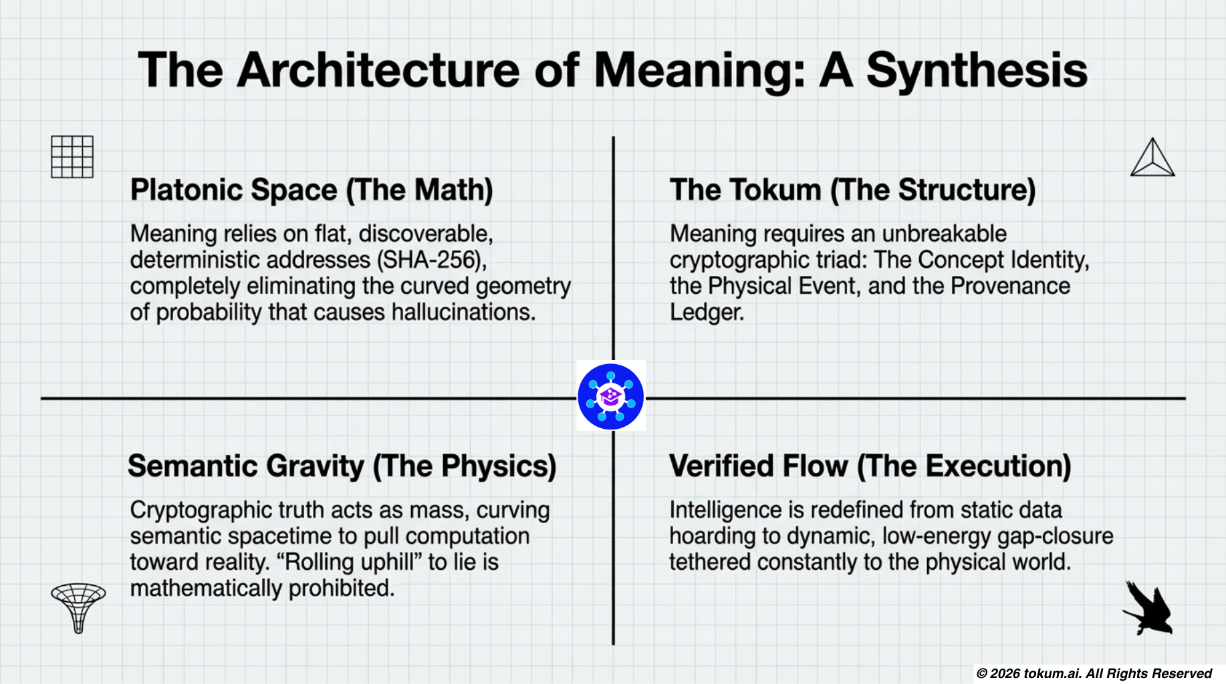
- The AI in the Windowless Room: Current Large Language Models (LLMs) are like geniuses who have memorized the statistical relationship of every word ever published, but are trapped in a sensory deprivation chamber with zero connection to the physical world. Because of this, AI hallucinations are not software bugs—they are a mathematical certainty.
- Digital Atoms of Truth: The video introduces a revolutionary building block for meaning called a "tokum," which securely locks together a unique cryptographic ID, a verified real-world measurement, and an unchangeable history log. By calculating a concept's identity with deterministic SHA-256 cryptography, meaning stops being a statistical guess and becomes a fixed mathematical fact.
- The Power of Semantic Gravity: See how this new architecture forces an AI to operate under an entirely new kind of physics. Every verified real-world measurement acts like a heavy object in spacetime, generating "semantic gravity" that literally curves the AI's computational space toward the truth. In this system, lying is incredibly expensive—hallucinating requires fighting against the cumulative weight of verified reality, making falsehoods an energetic impossibility.
Are we the architects of meaning, or are we just navigating a mathematical landscape that has been waiting in the dark? Tune into the podcast and watch the video to fundamentally alter how you view the line between mathematics, physical reality, and machine intelligence.