tokum.ai
The Semiotic Web: Nature's Blueprint for Computational Meaning
From Guessing to Knowing.
We are moving from Probability Tokens (which guess) to Tokums (which build structure). The Semiotic Web roots all computation in nature's own blueprint, transforming the digital world from a statistical game into a principled engine of understanding.
THE ACTIVE CRISIS
The AI Guessing Game: Why Current Tech Has Hit a Wall
Current AI has hit a structural wall. We have scaled probability, but we have lost meaning.
Traditional systems rely on "tokens"—static fragments that possess no inherent understanding. A classical token knows where it statistically fits, but it does not know what it is. It is a hollow shell.
The Result? A digital world built on probability rather than verified reality. To move beyond the black box of statistical approximation, we must rebuild the fundamental unit of computation itself.
REALITY BEYOND BINARY
The AI guessing game is not just an engineering bug; it comes from a structural mistake about what reality is. Classical computing flattens the world into inert 0s and 1s and then hopes that contextless signals will somehow produce genuine understanding. That hope has now been decisively challenged.
Federico Faggin — pioneer of the first commercial microprocessor — shows that physical reality behaves more like a superposition of possible meanings that only become definite in context, so it cannot be captured by bare binary logic alone.
Geoffrey Hinton — often called the godfather of deep learning — now warns that today’s large language models remain powerful pattern matchers that still confuse correlation with truth.
Yann LeCun — Turing Award laureate and architect of modern convolutional networks — argues that systems built only as “token generators” lack world models, reasoning, and hierarchical understanding.
Together, these three giants converge on the same message: scaling probabilistic models inside the binary trap will never deliver true comprehension.
The Semiotic Web begins where their critique ends — with an architecture that makes meaning itself the primary object of computation.
THE ENGINEERED SOLUTION
The Tokum: A Verifiable Unit of Reality
The solution is not just better software; it is a new atomic unit of computing. We introduce the Tokum (Token of Universal Meaning).
To transform the "guessing game" into an engineered architecture, we enforce two structural constraints. These are not just theoretical concepts; they are the anti-fragility requirements necessary to fix the web.
VISUALIZATION OF THE TRIADIC TOKUM STRUCTURE vs. LINEAR TOKENS
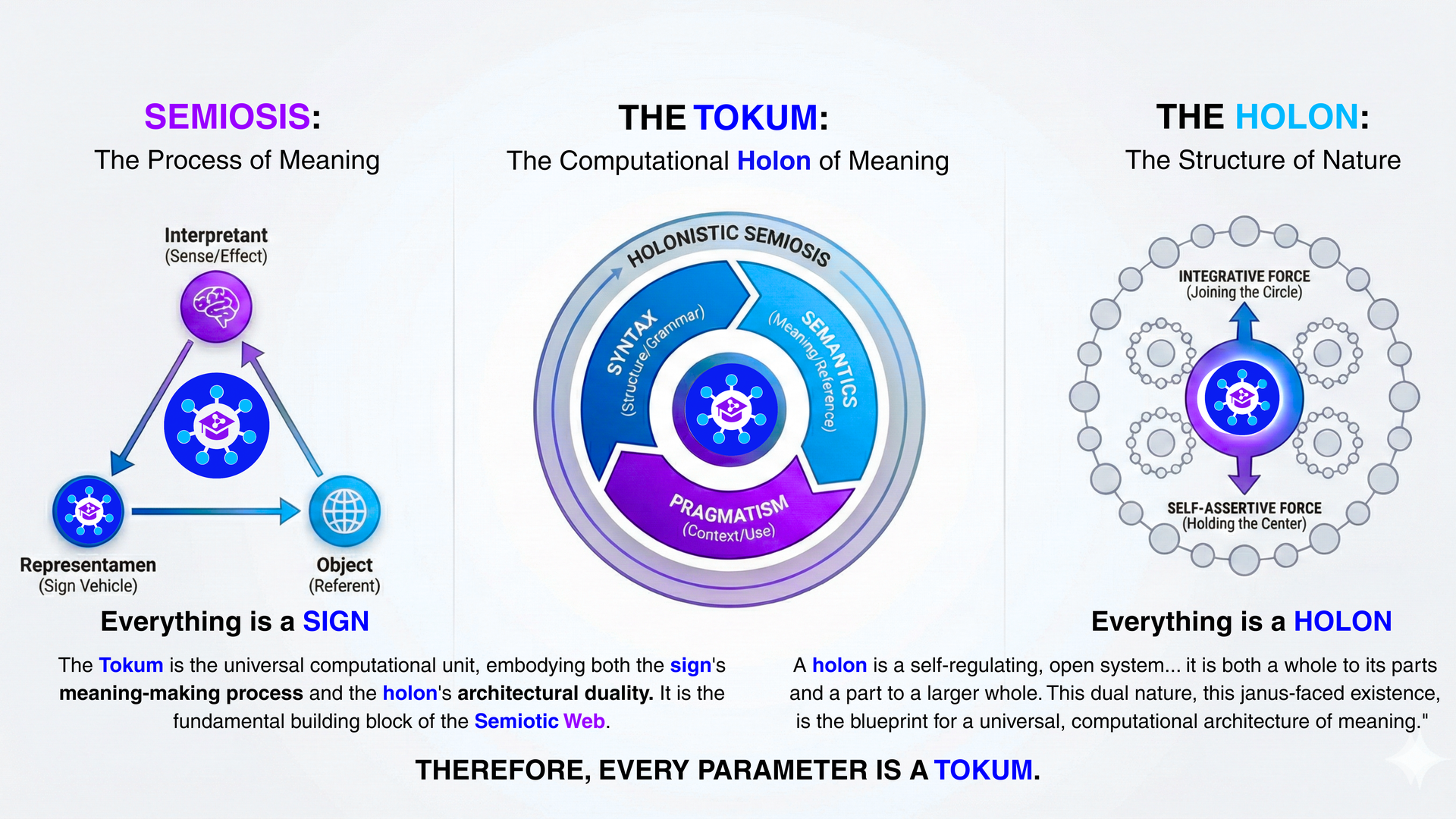
Contrast the linear probability token with the triadic Tokum structure
The Transparency Constraint: SEMIOSIS
The Irreducible Triad
Meaning is not a two-part relationship. It requires three irreducible elements working together:
The Representamen (sign vehicle) — what appears (the word, the symbol, the token)
The Object — what it actually refers to (the concept, the reality, the referent)
The Interpretant — the dynamic understanding created in a mind or system; the observer's context
Remove even one element, and meaning collapses entirely.
Current AI systems keep only Representamen and Object—they build correlations ("Paris" → GPS coordinates). They systematically delete the Interpretant, the observer's context, the layer that transforms raw correlation into genuine understanding.
Without the Interpretant, you have an empty relationship: words paired with things, but no significance, no consequence, no truth. This is why LLMs can generate coherent text that is fundamentally meaningless.
Because context travels with the data in every Tokum, the entire system is intrinsically transparent. Every answer can be traced back through explicit, inspectable relationships.
THE FOUNDATION OF MEANING
Charles Sanders Peirce — American philosopher, logician, and founder of semiotics — discovered that meaning is not created by processing symbols alone. Meaning requires three irreducible elements working together:
The Representamen (sign vehicle) — what appears (the word, the symbol, the token)
The Object — what it actually refers to (the concept, the reality, the referent)
The Interpretant — the dynamic understanding created in a mind or system; the observer's context
Remove even one element, and meaning collapses entirely.
Current AI systems commit a fatal reduction: they keep only Representamen and Object—they build correlations ("Paris" → GPS coordinates). They systematically delete the Interpretant, the observer's context, the layer that transforms raw correlation into genuine understanding.
Without the Interpretant, you have an empty relationship: words paired with things, but no significance, no consequence, no truth. This is why LLMs can generate coherent text that is fundamentally meaningless.
Peirce made a radical claim: "The entire universe is perfused with signs; if it is not composed exclusively of signs." This means reality itself is not inert, contextless data. Reality is fundamentally structured as signs—relationships, causalities, semantic density, significance.
To represent reality computationally, therefore, everything must be a sign: a three-part unit where Representamen, Object, and Interpretant are inseparably bound. This is the Tokum—the computational expression of Peirce's irreducible triad.
The Efficiency Constraint: HOLON
Nested Autonomy and Integration
Nature never builds gigantic centralized pyramids of control. Instead, it builds Holons: entities that are simultaneously:
a whole in themselves (autonomous, self-protecting, uniquely defined)
and a part of something larger (cooperative, contributive, structurally coherent)
Cells form tissues. Tissues form organs. Organs form bodies. Bodies form societies. At every level, the same dual logic holds: local autonomy balanced with global integration. This is why biological systems are simultaneously resilient and efficient.
Current AI systems violate this principle entirely. They centralize all computation into massive dense matrices where every parameter is opaque and interdependent.
The Semiotic Web applies this principle directly. Every Tokum is a Holon. As a whole, each Tokum has its own immutable identity and complete semantic DNA. As a part, each Tokum must fit coherently into larger semantic structures and maintain consistency with verified reality.
Only the relevant Tokums activate for a given task. The result: 99.75% sparsity—the network behaves like a living system, not a bloated computer. Locally autonomous. Globally efficient. Structurally resilient.
This is why the architecture achieves 400× energy reduction and 20,000× speed increase. This is not engineering optimization. This is nature's own operating system.
THE STRUCTURE OF RESILIENCE
Arthur Koestler — systems thinker, biologist, and philosopher — observed that nature never builds gigantic centralized pyramids of control. Instead, it builds Holons: entities that are simultaneously:
a whole in themselves (autonomous, self-protecting, uniquely defined)
and a part of something larger (cooperative, contributive, structurally coherent)
Cells form tissues. Tissues form organs. Organs form bodies. Bodies form societies. At every level, the same dual logic holds: local autonomy balanced with global integration. This is why biological systems are simultaneously resilient and efficient—they never depend on a single point of failure.
Current AI systems violate this principle entirely. They centralize all computation into massive dense matrices where every parameter is opaque and interdependent. A single corruption cascades through the entire system.
The Semiotic Web applies Koestler's principle directly: every Tokum is a Holon. As a whole, each Tokum has its own immutable identity and complete semantic DNA. As a part, each Tokum must fit coherently into larger semantic structures and maintain consistency with verified reality.
BEYOND FRAGMENTATION: FROM HYPERLINKS TO TOKUMS
The classical Semantic Web promised to transform the internet from isolated documents into a unified fabric of machine-comprehensible meaning. It rests on three architectural elements:
Hyperlinks are the web's essential binding agent—directional pointers that enable traversal and discovery. They remain foundational to both the web and the Semantic Web. Yet hyperlinks alone cannot carry semantic weight: they break through link rot, operate one-directionally, carry no verification of integrity, and are semantically hollow (pointing to location, not meaning).
RDF (Resource Description Framework) addresses this by encoding relationships as subject-predicate-object triples. SPARQL provides the query language. For the first time, machines can reason over shared knowledge structures.
Yet RDF-based systems face architectural limitations:
Rigid ontologies force complex reality into artificial constraints. Every domain creates incompatible taxonomies—medical, legal, scientific nomenclature all diverge. The system requires universal agreement on meaning—impossible in a decentralized world.
Binary relationships treat connections as flat edges in a property graph, not nested holonic structures capable of genuine depth.
No cryptographic verification means provenance remains invisible. A relationship in an RDF graph carries no guarantee of truth, authority, or integrity.
The Semiotic Web is built atop this foundation, replacing what hyperlinks and RDF alone cannot achieve:
Where hyperlinks point to locations, Tokums are content-addressable semantic holons secured by SHA-256 hashes—relationships that embed meaning and cannot break because they are verified by their cryptographic identity.
Where ontologies fragment into incompatible silos, Tokums maintain sovereign identity while automatically integrating through holonistic structure—coherence emerges without mandated agreement.
Where RDF offers no verification, Tokums embed provenance directly into their structure. Every relationship is traceable, verifiable, and cryptographically sound.
The Comprehensive Comprehension Cloud (CCC) is what the Semantic Web always meant to be: not documents linked through fragile pointers alone, but verifiable semantic relationships woven into living holarchic fabric.
THE DREAM THAT REFUSED TO DIE
Berners-Lee's Giant Global Graph Realized
Sir Tim Berners-Lee—the visionary who invented the World Wide Web, knighted by Queen Elizabeth II for "services to the global development of the Internet," and named in Time magazine's list of the 100 Most Important People of the 20th Century—didn't just create a system for linking documents. He dreamed of linking meaning itself. In 1999, he envisioned machines capable of understanding relationships with genuine comprehension. By 2007, this evolved into the Giant Global Graph (GGG)—a vision of humanity's knowledge woven into a living semantic fabric where context, causality, and truth could be verified cumulatively.
Berners-Lee has spoken with profound anguish about his creation's corruption: "For all the good we've achieved, the web has evolved into an engine of inequity and division; swayed by powerful forces who use it for their own agendas". His dream was betrayed not by the vision's inadequacy, but by the coordination problem his architecture could not solve. Fragmentation was inevitable. Universal ontologies were impossible. The Giant Global Graph remained theoretical.
The Semiotic Web solves this through holonistic architecture: Tokums replace fragile hyperlinks with content-addressable semantic holons that cannot rot; cryptographic provenance makes truth verifiable at scale; decentralized by design, the system restores knowledge to the commons while enabling individual sovereignty.
The Giant Global Graph was always possible in principle. The Semiotic Web makes it structurally inevitable.
THE REWARD MODEL
Every Parameter is a Tokum: A New Asset Class
Verifiable meaning has intrinsic value. But in the current digital economy, capturing that value is broken.
The Friction of the Old World
Currently, when a researcher or engineer creates a breakthrough, they face a nightmare of friction: opaque usage, complex licensing negotiations, IP lawyers, and years of delays before seeing a return on their intellectual property.
The Automation of the Semiotic Web
We have created a new asset class: Comprehension Units.
Because every Tokum is verifiable and content-addressable, we eliminate this friction entirely.
- Automated DRM & Reward System: Through a built-in DRM system, every interaction is tracked and honors its license terms automatically. Whether for open academic use or commercial application, the protocol ensures rights are respected without the need for middlemen or legal delays.
- Dynamic Valuation:Trust Scores do not just verify reliability; they dynamically determine influence. As your Tokum is used and verified by the network, its value adjusts in real-time based on proven utility.
- Sovereignty: Researchers retain sovereign ownership. A breakthrough in Japanese physics can instantly trigger insights in German chemistry, while the creator’s contribution is legally and structurally recognized
GOVERNANCE & ARCHITECTURE
Holonicracy: Governance by Nature’s Design
How do we govern a system of infinite complexity without a dictator? We use Holonicracy—the operating system of life
THE HOLARCHIC NETWORK MAP
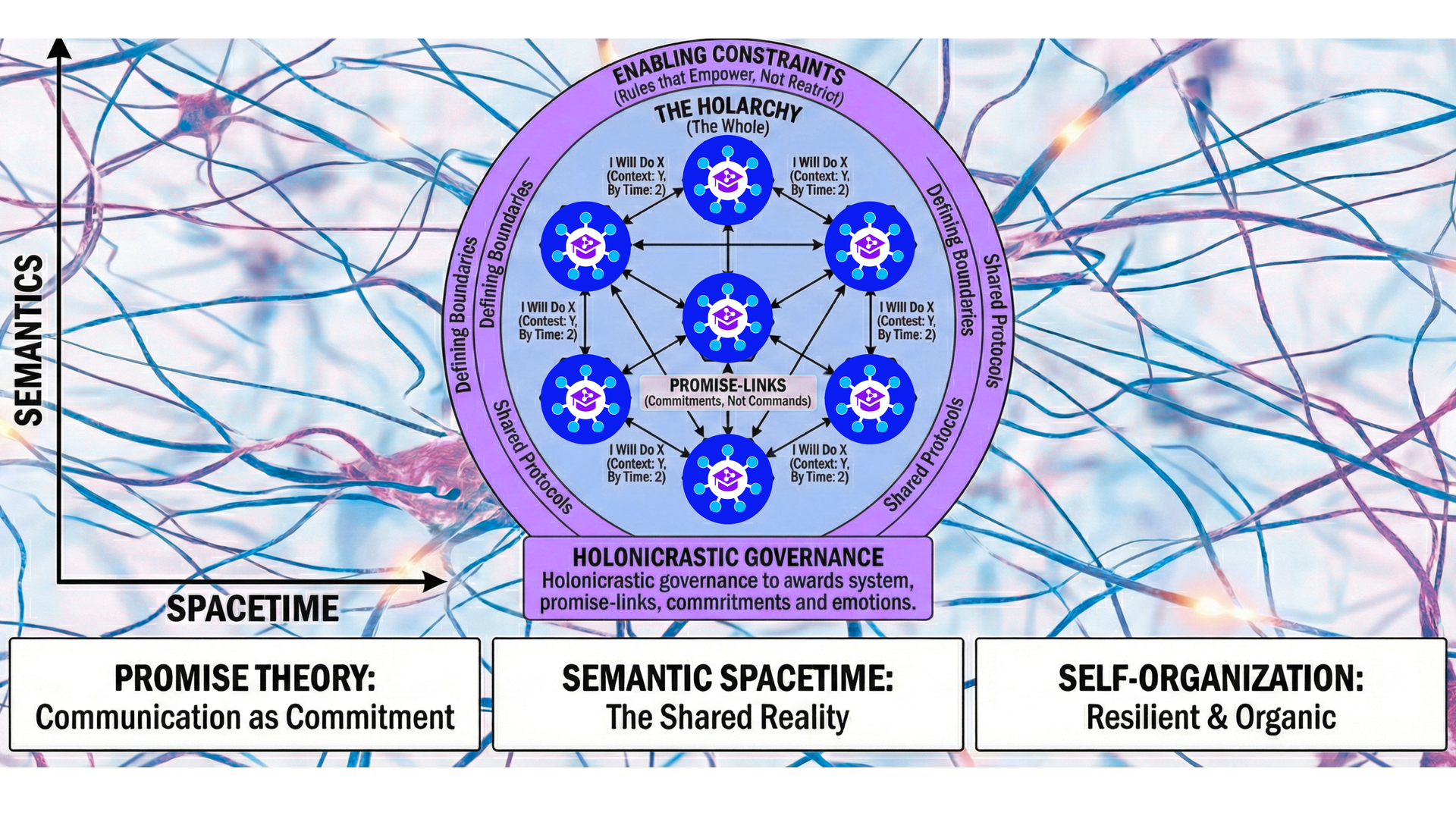
Visualization of the nested Holarchic structure showing Autonomy and Integration
Nature manages complexity through a balance of Autonomy (Self-Assertion) and Cooperation (Integration). The Semiotic Web embeds this governance directly into the structural fabric:
- Self-Assertion (Autonomy): Every Tokum maintains its unique definition and provenance. It cannot be overwritten by external pressure.
- Integration (Cooperation): Every Tokum must fit coherently into the larger context. If it contradicts verified reality, the network naturally rejects the connection.
Why This Solves the Alignment Problem
In a probabilistic system, "truth" is just the most likely word. In a Holonicratic system, truth is a structural requirement.
- No Dictator: No single authority controls meaning.
- No Chaos: Contradictions are naturally rejected.
REAL WORLD IMPACT
Reshaping Human Knowledge
- Science: Unifying global progress into a single, cumulative Holarchy where fraud is economically punished.
- Law: Legal precedents become verifiable assets. Courts can trace the genealogy of rulings across jurisdictions.
- Economics: The "Invisible Hand" becomes visible. Market signals transform into verifiable Tokums, replacing opaque speculation with transparent asset flows.
tokum.ai– Where Meaning Meets Intelligence
Watch Video
The Grand Narrative: How we are shifting the future of science, politics, and human understanding